Source Wedding Decoration Simulation Rose for Hotels, Banquets, and Homes
Find 30 options for wedding decoration simulation rose products in polyester and plastic. Compare sizes, colors, and packaging styles from Chinese manufacturers to find the right fit for your event needs; compare the available evidence and request quotations based on your requirements.
Key considerations
Products List








Comprehensive Sourcing Guide
Wedding Decoration Simulation Rose Sourcing Guide
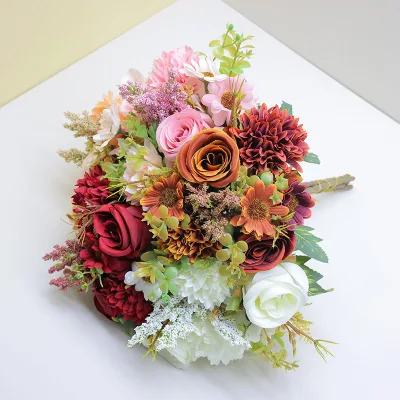
Simulation roses occupy a distinctive position in the wedding decoration supply chain because they must satisfy two audiences at once: professional event stylists who need consistent appearance across large installations, and retail channels that resell single stems or small bundles. The listings observed in this category span tulip and rose flower types, small stems under 30cm through medium 30–60cm and large formats such as 52*9.5cm, with origins in China including Zhaoqing, Guangdong. Materials center on polyester and plastic construction over iron wire, frequently handmade.
Before approaching suppliers, define your own program requirements: stem count per installation, color palette coverage, whether stems must be wire-bendable for arch and table styling, and whether packaging supports bulk carton delivery or retail-ready boxes. The observed category offers customization, OEM and ODM service, and both logo-printed and unprinted options, so decide early which commercial model fits your channel. A clear specification sheet issued before first contact shortens sampling cycles and prevents suppliers from defaulting to whichever stock item is easiest to ship.
Product Scope and Observed Listing Signals
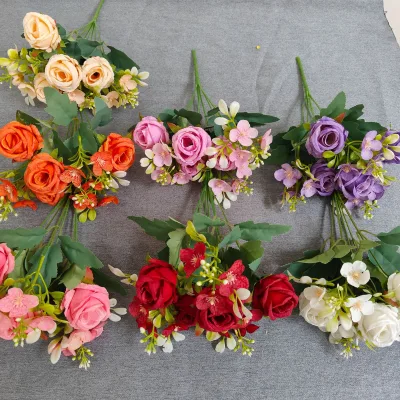
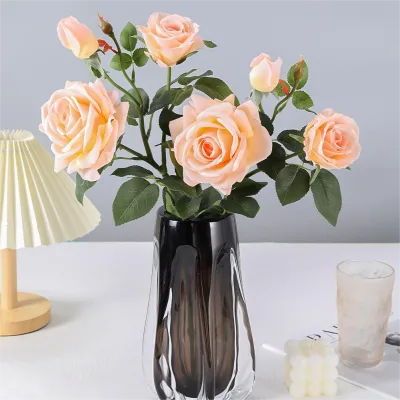
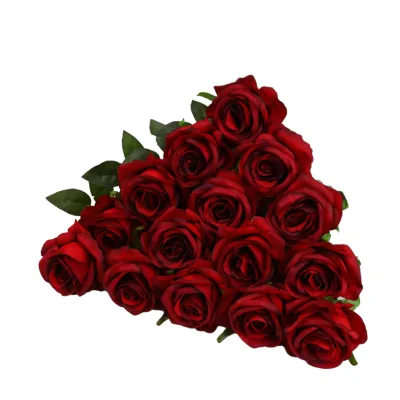
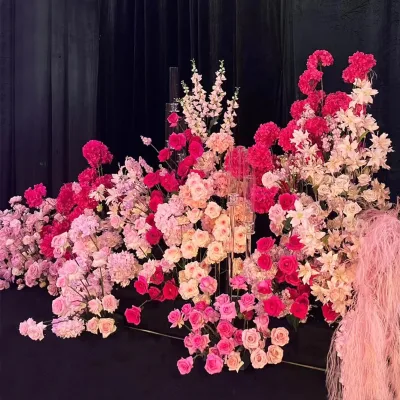
The observed product range divides into decorative single-stem roses for wedding and festival decoration, and fuller arrangements intended for home decor, hotels, restaurants, and banquet settings. Sizes range from small pieces under 30cm to medium formats of 30–60cm, with specific models such as 517cm flower heads and 529.5cm large stems. Color availability is broad: one listing family offers orange, red, two pink variants, beige, champagne, and purple, while another lists white, red, pink, green, champagne, purple, yellow, blue, and silver, and a third uses numbered styles from style-01 through style-08.
Pricing dispersion is significant, with observed listings from roughly $0.16 to $300, reflecting the difference between single polyester stems and finished large arrangements. Minimum order quantities likewise range from single-piece sampling to 1,440 units, so buyers should treat price tiers as inseparable from order volume. Product models in the data include HU5827-07, HU50827-06, HU50827-010, 030, T83XYC1809, and Hbm882bqt; recording model numbers against quotes keeps correspondence traceable when several similar-looking roses are under negotiation in parallel.
Technical Specifications to Verify
Request dimensional verification on every sampled SKU rather than relying on listing photographs. The observed data points—30cm stems, 517cm flower heads, a 1305080cm finished arrangement, and carton dimensions such as 1175753cm and 13050*80cm—show that both stem size and export carton geometry must be confirmed. Carton dimensions directly determine your container utilization and per-unit freight, so ask each supplier for full packing data: units per inner box, boxes per carton, gross and net weight, and whether packing is CTN, carton, box, or OPP bag plus carton.
Material composition deserves equal scrutiny. The category lists polyester, plastic, and iron wire as the standard construction, often assembled by hand. Confirm the petal fabric weight and finish, the wire gauge and whether stems hold a bent shape, and the adhesive points where petals meet calyx, since handmade assembly introduces unit-to-unit variance. One listing reports a weight of 14.8g per piece; establish whether such figures are averages or per-SKU values, and define an acceptable tolerance so incoming inspection has a measurable standard.
Compliance and Safety Documentation
Artificial flowers for wedding and home use generally face chemical and flammability scrutiny in destination markets, so ask suppliers which documentation they can produce for their polyester and plastic components. The observed listings include a "Certificate: Available" attribute, which signals that some suppliers maintain certification files, but it does not tell you which standard applies or which product lines are covered. Request the actual certificate documents and check that the applicant name, product model range, and validity dates match the SKUs you intend to order.
Beyond certificates, ask for material declarations covering the pigments and coatings used on dyed polyester petals, particularly for items sold to consumers or used around food at banquet settings. Suppliers advertising "non-polluting" and "immortal" properties are making product claims; ask what testing supports them rather than accepting marketing language. If your market requires specific flammability or restricted-substance compliance, state the requirement in the purchase specification and make shipment acceptance conditional on a passing report from a laboratory you recognize, not solely on the factory's internal documentation.
Cost Drivers and Commercial Terms
The main cost drivers in this category are material grade, flower head size, and assembly method. Handmade construction with layered polyester petals on wired stems costs more than molded plastic stems, which explains much of the spread between low-priced singles and higher-priced finished arrangements. Order volume is the second lever: observed MOQs span from 1 piece to 1,440 units, and the price band from $0.16 to $300 indicates that quote comparisons are only meaningful when volume, size class, and packing format are held constant across suppliers.
Commercial terms should be negotiated as a package. Confirm whether quoted prices include packaging as listed—bulk carton, box, or OPP bag plus carton—since switching packing formats changes unit cost. Clarify customization fees separately: the category shows customization available and OEM/ODM service, so ask whether color matching, logo printing, or custom labeling carries tooling or setup charges and at what quantity those charges are waived. Payment terms, sample cost, and whether sample fees are credited against first bulk orders should all be settled in writing before production begins.
Supplier Qualification and Quality Control
Qualify suppliers against the specific attributes your program needs. The observed data shows origin concentration in China, including Zhaoqing, Guangdong, with several suppliers advertising OEM, ODM, and customization capability. Ask prospective partners to identify which of their listed models—such as the HU5827 or T83XYC1809 families—can be produced to your color specification and packing requirement, and which are stock items only. A supplier who can map your requirement onto named existing models demonstrates genuine production familiarity rather than catalog breadth.
Quality control should combine a pre-production golden sample with defined in-process and final random inspection. Because the category relies on handmade assembly, set explicit inspection checkpoints: petal symmetry, color consistency against the approved sample under both daylight and warm event lighting, stem wire integrity after repeated bending, and adhesive cleanliness. Define the AQL level you require in the contract, and decide whether you will rely on supplier self-inspection, third-party inspection, or your own final audit. For repeat orders, retain sealed reference samples for both color and construction to arbitrate any dispute.
Long-Term Procurement Checks
Sustained sourcing success in this category depends on continuity of appearance across orders. Wedding palettes are trend-sensitive—champagne, dusty pink, and similar tones shift seasonally—so confirm at each reorder that dye lots remain within your approved tolerance. Suppliers listing numbered style variants (style-01 through style-08) and multiple pink designations (Pink-1, Pink-2, hot pink) show how easily near-identical colors diverge; lock each tone to a named model and a retained physical standard rather than a color name in correspondence.
Build annual reviews into the relationship. Reconfirm that certificates remain valid and still cover the shipped models, that packing configurations and carton dimensions have not drifted, and that material inputs—polyester fabric, plastic components, iron wire—remain unchanged, since silent material substitution is a common cost-saving move that degrades hand feel and durability. Track defect rates and claims by shipment, and share the data with your supplier to justify pricing discussions in both directions. Buyers who treat qualified simulation-rose suppliers as program partners, rather than interchangeable quote sources, consistently achieve better color continuity and fewer event-day surprises.
FAQs
Can wedding decoration simulation roses be customized for specific events?
Yes, customization is available for these artificial flowers. Buyers can request specific colors such as orange, red, pink, or purple to match their theme. The products support OEM and ODM services, allowing for tailored designs. This flexibility ensures that the simulation roses fit perfectly into various festival or home decoration requirements without compromising quality.
What materials are used to make these simulation roses?
These simulation roses are primarily made from polyester and plastic materials. The construction often includes iron wire for structural support, ensuring the flowers maintain their shape. This combination of fabric, plastic, and wire creates a durable and realistic appearance. The materials are selected to be non-polluting and long-lasting for repeated use in weddings or hotels.
What sizes are available for these artificial rose decorations?
Various sizes are available to suit different decoration needs. Options include small sizes under 30cm, medium sizes between 30cm and 60cm, and specific dimensions like 51x7cm or 52x9.5cm. Some models also offer a height of 10.5 inches. This range allows buyers to select the perfect scale for bouquets, centerpieces, or large event installations.
How are these wedding decoration roses packaged for shipping?
Packaging options vary based on order requirements and product type. Common methods include bulk packaging, boxed units, and carton shipments. Some items are packed in OPP bags within cartons for protection. The packaging is designed to prevent damage during transit, ensuring that the delicate artificial petals and stems arrive in pristine condition for immediate use in decorations.
Where are these simulation roses manufactured and shipped from?
These artificial roses are manufactured in China, specifically originating from Zhaoqing, Guangdong. This region is known for its production capabilities in decorative items. The products are exported globally, with certifications available upon request. Buyers can rely on established supply chains from this location to ensure consistent quality and timely delivery for their wedding or event planning needs.
What are the advantages of using simulation roses for weddings?
Simulation roses offer several key advantages for wedding decorations. They are immortal, meaning they do not wilt or require water. They are non-polluting and can be reused for multiple events. The handmade technology ensures a realistic look and feel. These factors make them a cost-effective and sustainable choice for creating long-lasting floral arrangements in hotels, restaurants, and banquet halls.